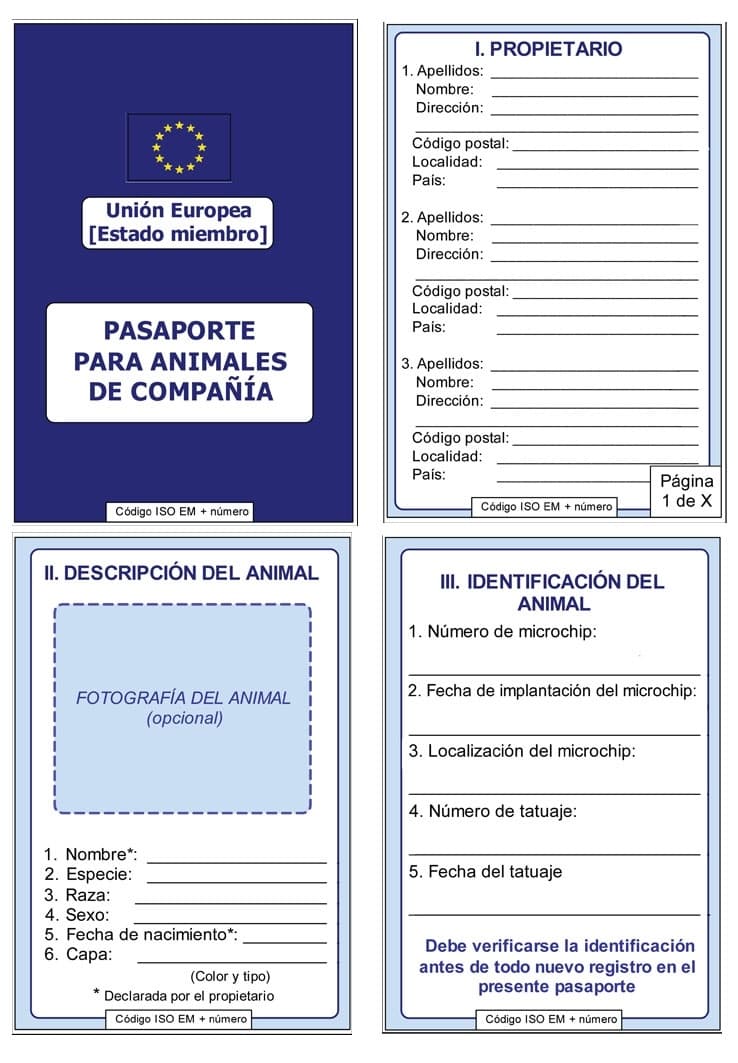
Knowing which papers your dog needs to travel is one thing. Knowing exactly what happens when you cross the border — what they ask, where they stop you, what they check, and what the consequences are if something's wrong — is another. This guide covers just that: the physical process of crossing, whether you're leaving Spain for another country or entering Spain from abroad.
Leaving Spain with your dog
To European Union countries
Within the Schengen Area, systematic border controls don't exist for European citizens. But that doesn't make documentation optional: random checks can happen, and when you arrive at your destination country (airport, port, or designated border crossing), they may ask for your pet's paperwork.
What you need to have on hand:
- European Pet Passport (the blue document with your dog's vaccinations, microchip, and personal details)
- Valid rabies vaccination — it must have been given at least 21 days before the date of travel
- ISO 11784/11785 microchip registered before the first rabies vaccination (if the order is reversed, the passport is not valid for border crossings)
In practice, pet checks at land borders within the EU are rare. At airports and ports, documentary checks are more systematic.
Where they may ask for documentation:
- At airline check-in or ferry boarding
- At passport control on arrival at your destination
- At any road checkpoint within the destination country
To countries outside the EU
Here things get more complicated, and it depends a lot on where you're going.
Morocco: To take your dog to Morocco you'll need an official veterinary health certificate issued by an authorised vet, dated no more than 10 days before travel. The document certifies that the animal is healthy, vaccinated, and free of parasites.
The process at Moroccan customs (Tangier, Nador, etc.) includes an official veterinary check where they review the certificate and may carry out a visual inspection of the animal. If the certificate is more than 10 days old or there are any irregularities, they can deny your dog entry. It's not a frequent situation, but it does happen.
United Kingdom (post-Brexit): The UK is no longer part of the EU and does not recognise the European Pet Passport. To enter the UK with your dog you'll need:
- AHC (Animal Health Certificate): issued by an official vet in the 10 days before arrival in the UK. Only a vet accredited by the Ministry of Agriculture can issue it.
- Antiparasitic treatment against Echinococcus tapeworm: administered between 24 and 120 hours before arrival. The date and time must be recorded on the certificate. The hours are exact — outside that window, the document is not valid.
- Valid rabies vaccination recorded in the AHC.
- Microchip registered before the rabies vaccination.
Veterinary checks at UK ports and airports are strict. If the AHC contains errors, if the antiparasitic was administered outside the required timeframe, or if the microchip doesn't match, the animal may be placed in quarantine or sent back.
Up-to-date official information: APHA (Animal and Plant Health Agency) — gov.uk/bring-pet-to-great-britain
Andorra: Andorra is not in the EU but is part of the Schengen Area. To cross the border with your dog, the European Pet Passport is sufficient. Controls are routine — there are designated border crossings at Pas de la Casa and La Farga de Moles, and customs officers typically ask for and check pet documentation.
USA, Canada, Australia: These are destinations with very strict entry processes, all different from one another and subject to frequent changes. As a general rule:
- They may require a quarantine period
- They may require a rabies serology test (which needs months of planning)
- An official veterinary certificate specific to each country
- In some cases, certain breeds are prohibited
The definitive source is always the official body of each country. For the USA: USDA APHIS. For Canada: CFIA. For Australia: DAFF. Start planning at least 6 months in advance for these destinations.

Entering Spain with your dog
From EU countries
Same setup as when leaving: European Pet Passport with microchip and valid rabies vaccination. Systematic controls at land borders are rare, but airports and ports may carry out checks.
Spain has official Border Inspection Posts (BIPs, known as POIIFs in Spanish) at major airports and ports. Animals arriving from non-EU third countries must pass through these points without exception.
From non-EU countries (entering Spain)
If you're bringing a dog from a country outside the EU — Morocco, the USA, Argentina, Mexico... — you'll need:
- European Pet Passport or, if the animal comes from a third country, an equivalent certificate recognised by the EU
- ISO 11784/11785 microchip
- Valid rabies vaccination (with the 21-day waiting period from the date of vaccination)
- In some cases, a rabies serology test — mandatory if the animal comes from certain countries not included on the EU's low-risk country list
- Antiparasitic treatment for certain countries (particularly for Echinococcus if the animal originates from a country with high prevalence)
The check takes place at the BIP at the entry airport or port. An official vet inspects the documents and may examine the animal. If everything is in order, the process takes just a few minutes. If there are irregularities, the animal may be held for a more thorough examination.
From the United Kingdom (the return journey)
To bring your dog from the UK to Spain:
- The UK no longer issues European Passports — the equivalent is the GB pet health certificate
- Valid rabies vaccination
- Microchip
- Possible antiparasitic treatment depending on the animal's origin
Check with SENASA (Spain's National Service for Agri-Food Health and Quality) or the Spanish Ministry of Agriculture for up-to-date requirements.
The rabies vaccination: what you really need to understand before crossing any border
The rabies vaccine is the number one requirement for crossing any border with your dog. But there are details about how it works legally that many people don't know — and that can turn a trip into a serious problem.
Order matters: microchip before vaccination
This is the most common mistake, and the easiest to avoid. The microchip must be implanted before the first rabies vaccination that will be used for international travel. If the vaccination is given before the microchip, that vaccine doesn't count for international border crossings — even if your dog is fully immunised.
If you've already made this mistake, there's no way to undo it: you'll have to wait until the next rabies vaccination (with the microchip already in place) and then let the corresponding waiting period pass.
The waiting period: 21 days
After each rabies vaccination, the law requires a minimum waiting period of 21 days before that vaccine is valid for crossing EU borders. Not 20, not 15 — 21 days minimum. The European Passport is not valid for international border crossings until that period has elapsed.
This means that if you're planning a trip and discover your dog's rabies vaccination expired last week, you can't travel abroad until 21 days after the revaccination.
When the vaccine expires
It depends on the product used. Some rabies vaccines are valid for 1 year and others for 3 years. Your vet records the next vaccination date in the passport — that's when the legal protection expires. If the vaccine expires while you're outside Spain, you'll need to get a booster in whatever country you're in, wait the 21 days, and then you'll be able to cross borders again.
The serology test (RNATT): when it's required and why it needs months of planning
For certain destinations outside the EU — Australia, New Zealand, Japan, some Pacific islands, and in certain cases the United Kingdom — the vaccine alone isn't enough: a rabies serology test (Rabies Neutralising Antibody Titre Test, RNATT) is also required.
This test measures the level of antibodies in your dog and must return a result of ≥0.5 IU/ml to be valid. But there's more:
- After the test comes back positive, many countries require an additional 3-month waiting period before the animal can enter
- The blood sample analysis can take 2–4 weeks to return results
- To take the test, the dog must already be vaccinated
The full chain for a destination that requires RNATT: vaccinate → wait 30 days → draw blood → wait for results (2–4 weeks) → wait 3 months = a minimum of 4–5 months of planning before your travel date. This is not something you can sort out the month before you leave.
Accredited laboratories in Spain for RNATT: the analysis is only valid if carried out by an EU-approved laboratory. Your vet can advise you on which one to send the sample to.
Rabies at customs: exactly what they check
When the vet inspector reviews your dog's documentation at the border, here's what they look at in relation to rabies:
- That the microchip is recorded in the passport dated before the first vaccination
- That the registered rabies vaccination is within its validity period on the date of crossing
- That at least 21 days have passed since that vaccination (if it was recent)
- For destinations requiring an RNATT: that the result is ≥0.5 IU/ml and that the required post-test waiting period has elapsed
- For the UK: that the AHC correctly records all of the above
A single failure in this chain can prevent the crossing or result in quarantine. This isn't bureaucracy for its own sake: rabies is a serious zoonotic disease and these controls exist for public health reasons.
What happens if something's not in order
At the exit border (leaving Spain)
If the inspector finds that the documentation is incorrect (expired passport, out-of-date rabies vaccination, microchip not properly registered):
- The animal may be turned back — not allowed to cross the border
- If you're flying or taking a ferry, the airline or shipping company may deny boarding
- There's usually no on-the-spot fine for the owner, but the incident is recorded
At the entry border of another country
The consequences vary considerably by country:
- EU in general: the animal is returned to the country of origin on the next available flight or ferry. The cost falls on the owner or the carrier.
- United Kingdom: if the AHC has a formal error or the antiparasitic was administered outside the required timeframe, the animal may be placed in quarantine at official facilities (at the owner's expense) until the situation is resolved. In serious cases, the animal may be ordered back.
- Morocco: entry denied; the animal returns to Spain with the owner.
At the entry border to Spain
If you bring an animal from a third country without the correct documentation:
- The official vet can order the animal to be held at the designated facilities at the airport or port, at the owner's expense
- Penalty proceedings may be initiated
- In cases of serious non-compliance (an animal with no rabies vaccination arriving from a high-risk country), the animal may be ordered to be destroyed or placed in extended quarantine
Situations this serious are uncommon, but it's important to understand that the consequences are real — and that the process doesn't automatically end with "you go home with your dog and that's that."
Practical tips to avoid problems
Plan ahead. Some documents, like the rabies serology test, require months of lead time because there are waiting periods after the test is carried out. The AHC for the UK can only be done in the 10 days before travel, but you need to arrange the appointment with an accredited vet well in advance.
Use a vet who specialises in international travel. Not all vets issue AHCs or know the specific requirements for third countries. If your destination has complex requirements, look for someone with experience in this area.
Bring copies of everything. Original passport + photocopy, email confirmation of the vet appointment, any correspondence with the authorities of the destination country. If there's a discrepancy, having a paper trail helps.
Allow plenty of time at airports and ports. Veterinary checks can add time to the boarding process. At UK entry points in particular, the check can be thorough.
Check official sources, not just blogs. Rules change. This article reflects the situation as of August 2026, but international veterinary requirements are updated regularly. Before you travel, verify with the official source in your destination country.

Official resources
- Spain (SENASA - Ministry of Agriculture): mapa.gob.es — animal health section
- EU (European Commission): ec.europa.eu/food/animals/movement-pets_es
- United Kingdom (APHA): gov.uk/bring-pet-to-great-britain
- USA (USDA APHIS): aphis.usda.gov/pet-travel
- Morocco: nearest Moroccan consulate or embassy
Frequently asked questions
Will I always be stopped at the border with my dog? Not systematically, especially at land borders within Schengen. But a check can happen at any time, and your documentation must always be in order.
Can I bring a dog into Spain that I picked up in Morocco? Yes, but it's more complex than travelling with your own. The animal must be microchipped, vaccinated against rabies (with the necessary waiting period observed), and may require a quarantine period or additional checks depending on the country of origin. Consult with the official vet at the point of entry.
What happens if my dog's passport expires during the trip? The European Passport itself doesn't expire — what expires is the rabies vaccination recorded in it. If the vaccine expires while you're abroad, you'll need to get a booster in whatever country you're in, have the vet record it in the passport, and wait for the validity period before crossing back.
Do I need to declare my dog at customs? For companion animals (a maximum of 5 animals per person, with justified exceptions), there's no customs declaration of monetary value. What there is, is the documentary veterinary check. If you're travelling with more than 5 animals, it's treated as a commercial import with different procedures.
What if I lose my dog's passport during the trip? Contact your vet in Spain so they can issue a duplicate (they can do this using the clinical history). In the meantime, there may be some flexibility in the country you're in, but to cross back into Spain you'll need a replacement document. Contact the nearest Spanish consulate for guidance.