When a puppy arrives home, your whole life plan shifts overnight. And among the thousand things piling up in your head — the vet, the vaccinations, the bed, the crate — travel becomes this wonderful idea you're not quite sure will ever happen. Can I take him already? Is he too young? What if the car makes him sick?
This guide exists so you don't have to figure all that out through trial and error. Here's everything worth knowing before your first trip with your new adventure companion: when they're ready, how to prepare them, what to pack, and how to make that first experience a lovely memory rather than a horror story.
When Can a Puppy Travel? Ages and Stages
There's no universal age at which you can suddenly travel without a care. It depends on the type of trip, the mode of transport, and your pup's vaccination status. Here's what we can tell you:
Under 8 weeks: not a chance. That time with their mother and siblings is non-negotiable — it's when they learn to relate to the world, manage frustration, and control their own strength. Separating a puppy before this point shapes them for life.
8 to 12 weeks: maximum caution. They can be with you, but their immune system is still developing and the vaccination schedule has only just begun. Short car journeys to the vet, yes. A weekend getaway to the mountains, not yet. The risk of contact with other dogs or contaminated surfaces at parks and motorway service areas is very real.
From 12–16 weeks onwards: with the first round of vaccinations complete and your vet's green light, you can start planning proper trips. Short, calm, and low-pressure.
From 6 months onwards: now you've got a young dog with much more stamina. Longer journeys are fine as long as you respect regular stops and their needs.
Up to one year: they're still a puppy. This matters because, for example, the new Renfe (Spanish rail) policy (in effect from July 2026) does not allow puppies under 1 year old on long-distance trains, regardless of size.
In any case, before planning that first real trip: visit your vet. They know your puppy's history and can give you the all-clear with proper knowledge behind it.
Documentation: Without This, You're Not Going Anywhere
Before you set off for the first time, make sure your paperwork is in order. No shortcuts here.
Microchip. Legally required in most Spanish regions and the only real way to identify your puppy if they get lost. Without a microchip, they effectively don't exist in the system. If you've adopted from a rescue or bought from a breeder, they're usually already chipped. If not, this is the very first thing your vet needs to do.
Health record (cartilla sanitaria). This is the document where vaccinations, deworming treatments, and vet details are all recorded. From your very first appointment, it starts to build up. Always carry it when you travel — you may be asked for it at your accommodation, at a vet's in your destination, or at a border crossing.
European pet passport. Only needed if you're leaving Spain. Your vet handles it, and it includes a full vaccination history including the rabies vaccine, which is compulsory for crossing borders and can't be given before 12 weeks. If you already have a trip planned, talk to your vet with plenty of time to spare: there are waiting periods between the vaccine and when the passport becomes valid.
More detailed information in our guide to [documentation for travelling with a dog].
Vaccines and Protection: There's No Getting Around This
An unvaccinated puppy shouldn't be walking on surfaces where unknown dogs have been. Parks, beaches, motorway service areas, hotel gardens — all carry the risk of diseases like parvovirus or distemper, which can be very serious in young puppies.
The basic vaccination schedule starts between 6 and 8 weeks and requires several doses spaced weeks apart. Until it's complete, protection isn't full. That doesn't mean your puppy is stuck indoors — you can carry them or keep them in a closed crate. What to avoid is direct contact with the ground in areas frequented by unknown animals.
And don't forget deworming, both internal and external. Fleas, ticks, and intestinal parasites don't check your puppy's age before striking. If you're heading to the countryside, mountains, or beach, it's especially important to have this covered. Talk to your vet about the right protocol for your puppy's age and your destination.
The Car: The Most Puppy-Friendly Way to Travel
Most first trips with a puppy happen by car, and it really is the best option. You control the pace, you can stop whenever needed, and you avoid the stress of crowded environments full of unfamiliar sights and smells.
Before the First Long Journey: Get Them Used to the Car
Putting a puppy in the car on travel day without any preparation is a recipe for chaos. Gradual introduction doesn't take much time and makes an enormous difference.
- Leave the car parked with the doors open. Let them go in, come out, sniff around. Treats if they feel brave enough to explore on their own.
- Get in with them and sit inside without starting the engine. Calm play, treats, good vibes.
- Engine on, car stationary. Let them get used to the sound and vibration.
- First journey of 5–10 minutes. Come straight home. Treats, good energy.
- Gradually longer journeys until you reach the distance you actually need.
Do this in the days before your trip and your puppy will arrive on travel day with the car already part of their world.
What You Need Inside the Car
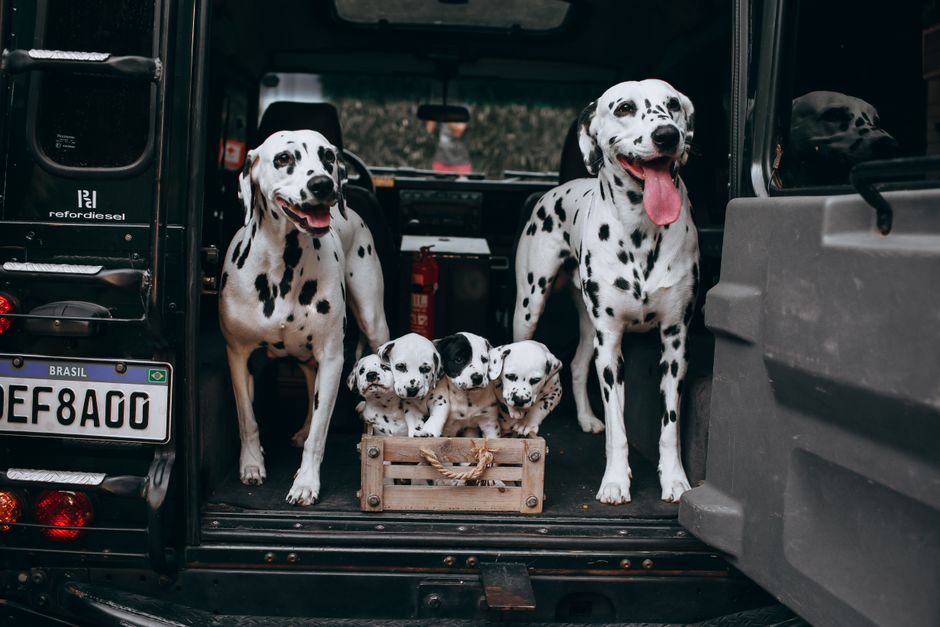
By law, your dog must be secured — either in an approved crate or with a travel harness. For puppies, the crate is usually the better option: it creates a small, safe space that many pups end up finding genuinely comforting, especially if you've been using it at home as a resting spot. Put their familiar blanket or a toy they already use inside — the familiar smell does far more than you'd think.
What to pack:
- Approved crate or harness (compliant with DGT regulations)
- Water and a collapsible bowl
- Their usual food (don't change their diet when travelling — their stomach will thank you)
- A familiar blanket or bed
- A toy or chew
- Wet wipes and poo bags
- Vet health record
Travel Sickness: More Common in Puppies
Puppies get carsick more often than adults because the vestibular system — the one that manages balance — isn't fully mature yet. It's something that usually improves on its own with time and gradual exposure.
The signs: excessive drooling, lots of lip-licking, restlessness, repeated yawning, and in clear-cut cases, vomiting. If you notice any of these, pull over as soon as you safely can.
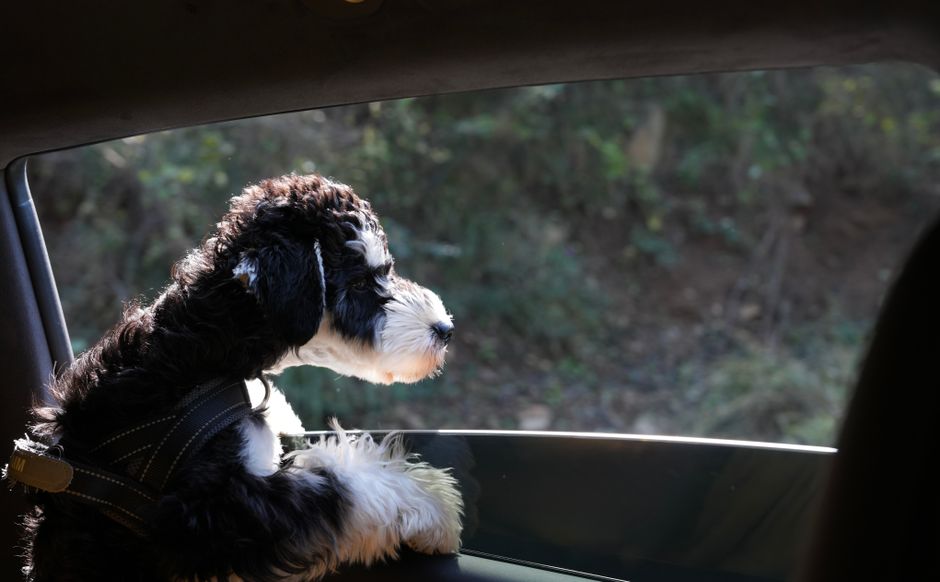
To reduce the risk: withhold food for 2–3 hours before setting off (a full stomach makes sickness worse), keep the car well ventilated, avoid letting your puppy stare out of the side window while driving, and make frequent stops. If the travel sickness is severe or keeps happening, speak to your vet — there are safe medication options for their age. We go into more detail in our guide to [anxiety and travel sickness in the car].
Stops
Every 45–60 minutes, stop. Even if your puppy seems to be sleeping. Let them out, stretch their legs, drink some water, and sniff at their own pace. Until vaccinations are complete, keep them away from areas with lots of unknown dogs — opt for a grassy spot away from the main service area.
Trains, Planes, and Ferries with a Puppy
Train
Renfe Cercanías and Media Distancia (short and medium-distance services): accept puppies of any size with a muzzle and lead. A solid option for urban trips or short journeys.
Renfe Larga Distancia (long-distance trains, new policy from July 2026): the pet carriages accept dogs up to 40 kg, but puppies under 1 year old are explicitly excluded. This restriction is enforced at boarding. If your pup is under a year old, Renfe long-distance trains are currently off the table.
FGC (Ferrocarrils de la Generalitat de Catalunya): accepts pets with a muzzle and lead, with no size restriction.
Full details on all Spanish train operators in our guide to [travelling by train with a dog].
Plane
Most airlines accept puppies in the cabin as long as the dog plus carrier doesn't exceed 8–10 kg. Above that, they travel in the hold. Flying isn't the recommended first option for a young puppy: stress levels are high, the carrier space in cabin is cramped, and managing their needs during the flight is genuinely tricky. If you can go by car or train, do that.
If flying is unavoidable, check the specific conditions of your airline before booking — they vary a lot between carriers. More detail in our guide to [travelling by plane with a dog].
Ferry
Ferries generally have designated areas for animals. Conditions vary depending on the operator and journey length — on short crossings dogs are usually on deck, on longer ones there's a kennel or a pet-friendly cabin. Call the ferry company before booking and ask specifically about puppies. More info in our guide to [travelling by sea with a dog].
Heat: A Greater Risk for Puppies
Puppies regulate their body temperature less effectively than adults and are more vulnerable to heatstroke. In summer, this really matters.
In the car, never leave your puppy alone even for "just a minute" — the inside can reach 50°C in minutes. Parking in the shade doesn't solve the problem.
At your destination, adapt your plans around the heat. In summer, go out before 9am or after 7pm. Hot tarmac can burn their paw pads — if it's too hot for your hand, it's too hot for their paws.
Signs of heatstroke: excessive panting, heavy drooling, staggering, red or purple gums, loss of consciousness. Any of these is a veterinary emergency. On the way to the clinic, wet their paws and belly with cool water (not ice cold) and ventilate the space.
Accommodation with a Puppy
There's a common trap here: a place being "pet-friendly" doesn't guarantee it accepts puppies. Some have age restrictions — and fair enough, since puppies chew, scratch, and have accidents far more readily than adult dogs.
Before booking, call directly and ask: "Do you accept puppies of X months?" Don't assume the pet filter covers everything.
Once you're at the accommodation:
- Bring their usual bed or blanket — familiar smells reduce anxiety in a new environment
- In the first few minutes of the room: let them explore at their own pace without overwhelming them
- Don't leave them alone until they've settled — the first hours or even the first full day can be very hard for a puppy in a new space. Barking, accidents, or chewing things are all normal signs of anxiety. Don't rush them
How Long Can They Be Left Alone
Not long. Puppies under 6 months shouldn't be left alone for more than 2–3 hours, and in an unfamiliar environment that window is even shorter. If your plans include visiting places where they can't come in, organise taking turns or look for accommodation with a doggy daycare service.
If Your Puppy Gets Ill Away from Home
It's one of those things that needs to be on your radar. The most useful thing you can do is arrive at your destination with this information already sorted:
- Locate the nearest vet clinic to your accommodation before you need it — ideally one with 24-hour emergency care. On our website you'll find a directory of vets with emergency services by province.
- Keep your regular vet's number handy for quick phone consultations.
- Have your dog's details ready: weight, date of birth, vaccinations, any medication they're on.
Symptoms that can't wait: repeated vomiting with blood, breathing difficulties, seizures, a very swollen abdomen, loss of consciousness, signs of heatstroke. Everything else can wait while you phone your regular vet for advice.
The First Trip Has to Go Well: Practical Tips
That first trip teaches your puppy what travelling means. If it's a positive experience, the next one will be easier. If it's chaotic and exhausting, you'll have some recovery work ahead of you.
Start short and close to home. The first real trip: under an hour in the car, a calm destination, 1–2 nights. It doesn't need to be spectacular — it needs to go well.
Keep their routines. Same mealtimes, same food, a similar rhythm of walks and rest. Your puppy doesn't know they're on holiday — abrupt changes create unnecessary anxiety.
Don't overstimulate them. A puppy's energy in a new environment can seem limitless, but their brain is processing an enormous amount of new information. After all that novelty comes the crash. Respect rest time without pushing for more stimulation.
Accept that things will happen. There will be vomit in the car, an accident in the room, a restless night, or a battle with tiredness. It comes with the territory. With patience and consistency, every trip gets a little easier than the last.
Give yourself credit for doing this. Travelling with a puppy is a learning process for both of you. The perfect trip doesn't exist — but the one that lays the right foundations for the adventure companion you want by your side in five years' time? That one absolutely does.
What to Pack for Your Puppy: The List
- Approved crate or travel harness
- Their usual bed or blanket (with their smell on it)
- Food (enough for the whole trip plus a little extra)
- Water from home (changes in water can sometimes upset their stomach)
- Water bowl and food bowl
- Poo bags and a dispenser
- Wet wipes
- A favourite toy or chew
- A spare lead
- Muzzle (even if it's not compulsory at your destination, some places require one)
- Health record and documentation
- An old towel
- The destination vet's number written down
Pre-Departure Checklist
- [ ] Vet has given the green light for the trip
- [ ] Vaccinations up to date for their age and destination
- [ ] Internal and external deworming up to date
- [ ] Microchip registered
- [ ] Health record stored in your bag
- [ ] European pet passport if leaving Spain
- [ ] Accommodation confirmed as accepting puppies
- [ ] Destination vet clinic located
- [ ] Puppy acclimatised to the car (gradual journeys done beforehand)
- [ ] 2–3 hour fast before setting off
- [ ] Dog's bag packed (see list above)
Most Frequently Asked Questions
At what age can my puppy do their first long journey? It depends what you mean by long. At 3–4 months with their first vaccines done, they can handle 1–2 hours in the car without a problem if they're acclimatised and you stop every hour. Longer journeys of 4–5 hours are more manageable from around 6 months, when their body copes better.
Will my puppy always get carsick? Probably not. Many puppies grow out of it with age and gradual exposure. If the sickness is severe, speak to your vet before the next trip — there are ways to manage it.
Can I take my puppy on holiday outside Spain? Yes, but you'll need the European pet passport with the rabies vaccine recorded. That vaccine can't be given before 12 weeks and has specific validity periods. Plan ahead and speak to your vet well in advance.
Can a pet-friendly hotel accept my booking and then refuse entry because I have a puppy? It shouldn't happen if you've booked correctly, but misunderstandings do occur. That's exactly why we recommend calling before booking and explicitly confirming they accept puppies. Keep the confirmation in writing (email or message).
How long can my puppy be left alone at the accommodation? Not long at all, especially in the first few hours somewhere new. Under 6 months, a maximum of 2–3 hours, and only if you're sure they can't hurt themselves or cause damage. In an unfamiliar environment, even less.
Can my puppy go to the beach? Yes, with some precautions. Make sure they don't drink saltwater (it causes diarrhoea), that there's shade available, that they're not on hot sand during peak sun hours, and that their parasite prevention is up to date. Check whether the beach you're planning to visit has any dog restrictions — during the bathing season many beaches ban dogs. You'll find information about dog-friendly beaches in our [activities] section.
What's Next?
If your puppy is nearly trip-ready, these guides will help you get everything in order:
- [Documentation for travelling with a dog]: microchip, health record, European pet passport
- [Anxiety and travel sickness in the car]: how to prevent and manage motion sickness
- [Travelling by car with a dog]: DGT regulations, safety, and tips for long journeys
- [Where do I start]: a guide for the first trip, packing, and full planning