
Your dog has a mobility limitation, an amputation, is blind, or has a condition that makes things complicated. And you still want to travel with them. Good. Because you can.
This guide exists to give you the concrete tools you need: what to ask before booking, what to pack, which transport to choose, and what to look out for depending on your companion's specific disability. No magic, no empty promises. Just real preparation so the trip actually works.
Important note: assistance dogs
Before getting into the general guide, it's worth separating two distinct categories.
If your dog is an officially certified assistance dog — a guide dog for a blind person, a service dog for someone with reduced mobility, an epilepsy alert dog, etc. — the law guarantees access to all public spaces, means of transport, and accommodation in Spain. This isn't a favor from the property owner: it's a right recognized by Law 10/2022 on Animal Welfare and the corresponding regional regulations. Carrying the documentation that certifies their assistance dog status is essential to exercise that right without friction.
If you have a disabled dog that is not an officially certified assistance dog — a tripod, a paraplegic dog, one that was born blind — the conditions are the same as for any other dog. There are no additional access rights based on the animal's disability. What does change is the logistics of the trip, which requires more planning.
First, understand what your companion actually needs
Not all disabilities call for the same adaptations. Planning without being clear on this is just wasted effort.
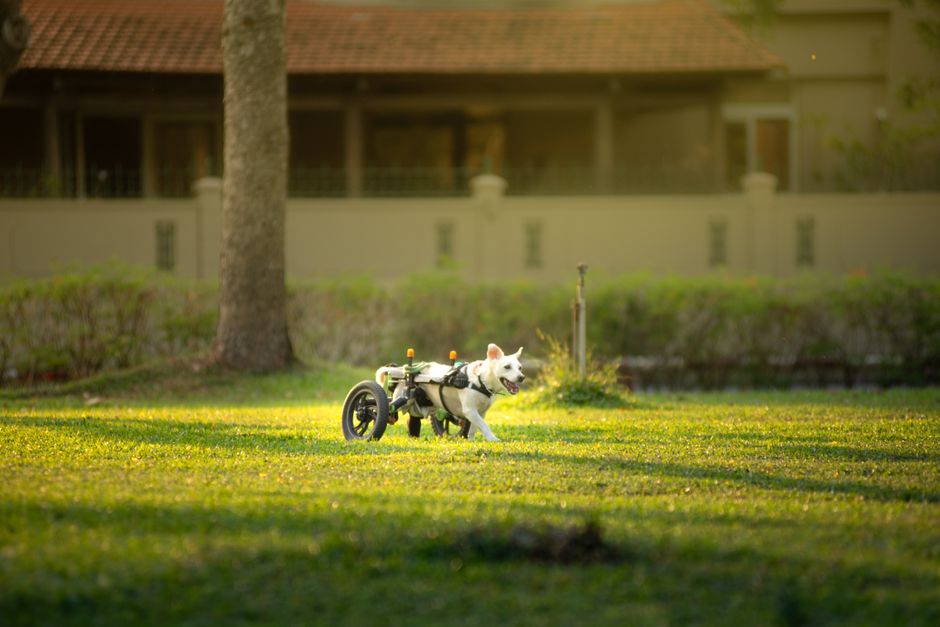
Partial paralysis or paraplegia (from IVDD, severe dysplasia, or spinal injury): your dog likely uses a canine wheelchair or a rear-support harness. Slippery floors are their number one enemy. If they still have some sensation in their hindquarters, uneven terrain will tire them out much faster than it would a healthy dog.
Amputation (the beloved "tripods"): they adapt surprisingly well, but they tire more quickly. They need more stops, shorter distances, and attention to uneven surfaces. Loose sand, coarse gravel, and steep slopes all take a bigger toll on them.
Blindness: the transport itself isn't the main issue. The real challenge is new environments, which cause disorientation and stress. Changes in routine should be kept to a minimum, the accommodation space should be as predictable as possible, and you need to give them time to explore each new area before letting them loose.
Deafness: what changes most is communication. They can't hear you calling them or react to audible danger signals. It's best to always keep them on a leash — even on beaches or parks where dogs usually run free — and to use visual or tactile signals they already know.
Urinary or fecal incontinence: this doesn't prevent traveling at all. It does require logistics: diapers, incontinence bands, waterproof bedding, and more frequent stops than usual. With all of that organized, there's no real obstacle.
The vet visit before you leave
With any dog that has an active medical condition, a vet visit before the trip is not optional.
You need to know:
- Whether your dog's current condition is stable enough for travel
- Whether the current medication is sufficient or needs adjusting
- Whether there are any new symptoms that need to be evaluated before you leave
- An up-to-date medical report with diagnosis, medication, dosage, and the clinic's contact details
If your dog regularly does physiotherapy or hydrotherapy, look into whether there's a way to continue it at your destination — some animal rehabilitation clinics take appointments for visiting patients. It's not always possible, but it's worth asking.
Transport: which to choose and how to adapt it
The car: the default option
For a dog with a disability, the car is almost always the first choice. You have total control over the pace, you stop whenever needed, and you avoid the obstacles of stations, airports, and access points that aren't always designed with a canine wheelchair or a dog that can't jump in mind.
The essentials: a portable non-slip ramp. Jumping into the boot is out of the question. There are affordable options that fold up easily — you'll find product recommendations on queviajemasperro.com [Amazon link]. The wheelchair travels disassembled during the journey: it takes up little space and can be put together in minutes.
Inside the car: a non-slip mat in the boot, a blanket or bed with a familiar smell, and enough space to shift position a little. For dogs with hindquarter paralysis, make sure they're not pressed against the side of the car throughout the journey.
Stop every hour and a half. Stretch, water, toilet break. With a disabled dog, rest stops are not a luxury.
Train
The new Renfe (Spanish rail) long-distance regulations (July 2026) open access to dogs up to 40 kg in specific carriages with a 40€ supplement. This is a genuine option for medium or large disabled dogs, as long as their condition doesn't make managing the journey difficult.
Things to consider: platform access, getting on and off the carriage, the constant movement of the train. If your dog uses a wheelchair, confirm with Renfe that the carriage has enough space to maneuver.
On Cercanías (commuter trains) and regional services, access is unrestricted with no size limit.
For officially certified assistance dogs, access is guaranteed on all trains with no size restriction and no additional cost.
Plane
Flying is the most complicated option and the one that requires the most thought.
- Dogs that fit within the cabin weight limit (dog + carrier, up to 8–10 kg): they can travel in the cabin, though prolonged immobility may be uncomfortable depending on the animal's condition.
- Above that weight: hold. The added stress can destabilize a dog with a neurological condition. Before booking, talk to your vet. This isn't a formality — it's a necessary conversation.
Officially certified assistance dogs travel in the cabin alongside their owner with no size restriction and no additional cost, in accordance with European regulations.
Accommodation: the questions you need to ask before booking
The fact that they accept dogs doesn't mean the accommodation will actually work for your companion. These are the specific questions you should ask before confirming:
Does the access to the room involve stairs, or is there a lift? For a dog in a wheelchair or with paralysis, a front staircase complicates everything. Don't trust the photos: call and ask directly.
What type of flooring do they have? Polished parquet or smooth ceramic tiles are a real problem for a dog with weakness in the hindquarters. If they can't confirm the type, pack some lightweight rollable non-slip mats in your luggage — they weigh almost nothing and solve a lot.
Is there enough space to maneuver? A canine wheelchair needs room. A studio packed with furniture can become a constant obstacle course. Prioritize apartments or rooms with real open space.
Does the exit to the outside have steps? If your companion has incontinence or needs frequent trips outside, a garden or patio that's directly accessible from the accommodation makes a huge difference.
On queviajemasperro.com we filter accommodations with accessibility information — the same features designed for people with reduced mobility tend to be the most comfortable for dogs with wheelchairs or mobility difficulties.
Activities: what works and what needs adapting
What works well:
- Walks on flat, firm ground: compact dirt paths, boardwalk promenades, urban parks with hard surfaces
- Restaurant terraces where they can lie down comfortably
- Accommodations with a garden or outdoor terrace where they can move around without a leash
- Small, quiet destinations with low foot traffic and minimal stimulation (especially good for blind dogs)
What needs adapting or avoiding:
- Loose sand (tripods sink in and tire much faster)
- Rocky or very uneven terrain (fall risk for dogs with partial paralysis)
- Very crowded or noisy beaches (especially for dogs with anxiety or cognitive decline)
- Hiking routes with significant elevation changes
The trick with a disabled dog is to choose the destination with them in mind before thinking about yourselves. A quiet spot where they can explore safely is worth far more than the most beautiful corner of the country if getting there is a logistical nightmare.
When travel isn't the best option
It makes sense to say this clearly.
If your dog's condition is unstable. A recent IVDD relapse, surgery within the last 30 days, or new symptoms without a diagnosis are all signs that they need stability, not movement.
If the stress of travel could worsen their condition. Some dogs with neurological issues are destabilized by sudden changes of environment. If your vet warns you about this, listen to them.
If they need care you can't guarantee away from home. Daily physiotherapy, specific dressings that need regular changing, or medication that requires refrigeration are factors that genuinely complicate travel. Think this through before booking anything.
If you really need to rest. Traveling with a disabled dog takes more energy, more planning, and more ability to improvise. If you're at a point where you need to completely switch off, sometimes the best decision is to leave them with someone you trust. That's not abandoning them — it's loving them well.
Packing list: what can't stay at home
- Portable non-slip ramp (for the car and for steps at the accommodation)
- Foldable canine wheelchair if they already use one at home
- Rear-support harness for short stretches or uneven surfaces
- Rollable non-slip mats
- Diapers or incontinence bands + a generous extra supply for the unexpected
- Waterproof bedding
- Full medication supply with prescription if controlled + extra days as a buffer
- Up-to-date veterinary report (diagnosis, medication, dosage, clinic contact details)
- Health record and up-to-date documentation
- Phone number of a vet at your destination (and if they do physiotherapy, an animal rehabilitation clinic if possible)
- A specific, easily accessible bag containing only your dog's things
Frequently asked questions
Can a dog that uses a canine wheelchair travel by train or plane? Yes. The wheelchair travels disassembled, takes up little space, and in most cases doesn't count as special luggage. On Renfe long-distance trains (new regulations from July 2026), dogs up to 40 kg are allowed in specific carriages. Always confirm the conditions of the specific ticket you're booking.
Can a blind dog travel comfortably? Yes, with adaptations. The main challenge is the new environment: they need time to explore it with their nose before you let them roam freely, stable routines, and an accommodation space that isn't an obstacle course. With that sorted, they travel perfectly well.
What documentation do I need? The same as for any dog: health record, registered microchip, European passport if you're traveling outside Spain. If they take controlled medication, bring the prescription. If they're an officially certified assistance dog, document that status.
Are there accommodations specifically adapted for dogs with reduced mobility? There's no official category, but there are accommodations that work perfectly well by virtue of their architecture or layout. The key is to ask directly and in detail before booking.
Is there a recommended maximum distance for traveling with a paraplegic dog? There's no fixed rule. It depends on the dog, their stability, and how well they tolerate transport. Start with short journeys, observe how they respond, and gradually extend the range.
How do I know if my dog is comfortable during the trip? Watch for signs of stress: excessive panting, constant movement, whimpering, or trembling. If any of these appear, pull over as soon as you can and give them time to calm down. A comfortable dog isn't one that endures the most without complaining — it's one that arrives at the destination in good shape.