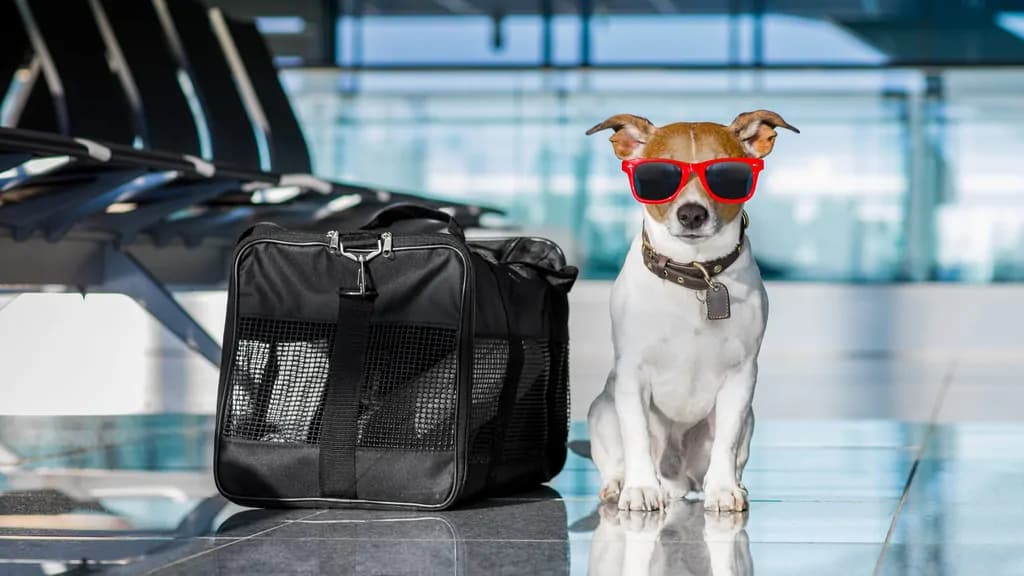
Flying with your dog is absolutely doable — but not with every airline, not with every size dog, and definitely not without preparation. The gap between "I can fly with my dog" and "I can fly with my dog on THIS airline, on this route, with this carrier" is exactly where most problems crop up.
This guide gives you practical, up-to-date information: which airlines accept pets, what it costs, what paperwork you need, how to navigate the airport, and how to prepare your companion so the flight is as stress-free as possible for both of you.
A heads-up before we dive in: airline policies change. Always confirm on your airline's official website before buying your ticket. What you read here covers general rules — your specific ones live on your airline's website.
Cabin or hold: the most important decision you'll make
This distinction directly affects how your dog experiences the flight, so it's worth taking a moment to think it through.
In the cabin: the ideal option
If your pet is small and the combined weight — dog plus carrier — doesn't exceed 8–10 kg depending on the airline, they can fly with you in the cabin. The carrier goes under the seat in front of you, your companion stays in your line of sight, and the stress levels for both of you are much more manageable.
Pet spots in the cabin are limited — typically 1–3 per flight, depending on the airline and aircraft. Always book in advance and explicitly confirm you're travelling with an animal. Mentioning it at the airport is not enough.
Brachycephalic breeds in the cabin: Bulldogs, pugs, boxers, Boston Terriers, Shih Tzus, and similar flat-faced breeds have compressed airways that cause breathing difficulties under stress and at altered cabin pressures. Many airlines restrict or ban them even in the cabin. If your dog has a flat face, check your airline's specific policy — don't assume anything.
In the hold: what you need to know before you decide
For dogs that exceed the cabin limit, the option is the aircraft's pressurised hold. Temperature and pressure are regulated — it's not the uncontrolled space people sometimes imagine. But the noise, darkness, vibration, and separation are real.
For healthy, adult dogs without severe anxiety, the hold on short or medium-haul flights is usually manageable. For older dogs, those with cardiac or respiratory conditions, dogs with high anxiety, or flat-faced breeds: talk to your vet before considering it. There are situations where the most honest answer is that flying simply isn't the best option.
Do not give sedatives without explicit veterinary guidance. Sedatives can be dangerous at flight pressures and reduce your dog's ability to regulate their body temperature. No airline recommends them. If your dog has significant anxiety, there are safer alternatives — check with your vet.
Airlines that accept dogs: current policies
Iberia
Iberia accepts pets in the cabin (dog plus carrier, maximum 8 kg) and in the hold for larger dogs in an IATA-approved hard carrier. They do not accept brachycephalic breeds in the hold on long-haul flights for safety reasons.
Approximate price: €25–60 in the cabin on European routes; more on long-haul and in the hold. Varies by route and season. The surcharge is not included in the ticket — it's added at the time of booking.
Website: iberia.com | Phone: 900 111 500
Vueling
Vueling allows pets in the cabin with a maximum of 10 kg (dog plus carrier), provided the carrier meets their published dimensions. Larger dogs are accepted in the hold under specific conditions. Restrictions apply to brachycephalic breeds.
Approximate price: €35–50 in the cabin on European routes. Check the website for hold transport and international routes.
Website: vueling.com | Phone: 931 51 84 07
Air Europa
Accepts pets in the cabin (up to 8 kg, dog plus carrier) and in the hold for larger dogs. Restrictions for brachycephalic breeds and some international routes.
Approximate price: around €25 in the cabin on European routes; more in the hold and on transatlantic flights.
Website: aireuropa.com | Phone: 911 401 501
Iberia Express
Operates as a regional airline within the Iberia group. Accepts pets in the cabin (up to 8 kg) on short and European routes. Conditions are similar to Iberia, but confirm on their website as the policy can differ in the details.
Website: iberiaexpress.com
Volotea
Volotea does accept pets on some routes — a point in its favour compared to other low-cost carriers. Approximate cabin weight limit: 10 kg (dog plus carrier). Conditions vary by route. Book at the same time as your ticket.
Website: volotea.com
Ryanair
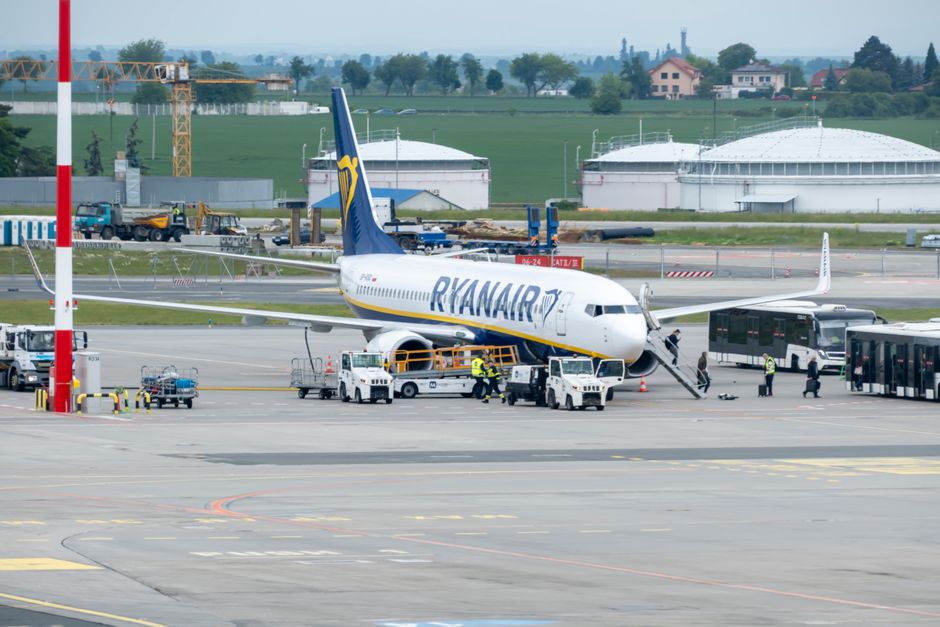
Does not accept pets on board on flights from Spain, except for officially accredited guide or assistance dogs. If you're flying Ryanair, your dog cannot come with you. No exceptions.
Website: ryanair.com (to confirm assistance animal policy)
EasyJet
Similar policy to Ryanair: does not accept pets in the cabin on most European routes. Assistance dogs are permitted with documentation. For everyone else, you'll need an alternative.
Website: easyjet.com
Airline summary
| Airline | Cabin | Hold | Brachycephalic breeds | Approximate price (cabin) | |---|---|---|---|---| | Iberia | Yes (up to 8 kg) | Yes | Hold restrictions on long-haul | €25–60 | | Vueling | Yes (up to 10 kg) | Yes | Restrictions | €35–50 | | Air Europa | Yes (up to 8 kg) | Yes | Restrictions | €25+ | | Iberia Express | Yes (up to 8 kg) | Check website | Restrictions | Check website | | Volotea | Yes (up to 10 kg, select routes) | Unclear | Check website | Check website | | Ryanair | No | No | N/A | — | | EasyJet | No | No | N/A | — |
Prices are indicative and subject to change. Always confirm on the official website before booking.
The paperwork: deadlines you cannot leave to the last minute
For domestic flights (within Spain)
A registered microchip and an up-to-date vaccination record. Airlines may ask to see it at check-in.
For flights within the EU
European Pet Passport — issued by your authorised vet and including:
- Microchip details (ISO 11784/11785)
- Valid rabies vaccination (must have at least 21 days' validity from the vaccination date, administered with an approved vaccine)
- Relevant health history
For flights outside the EU
This is where timelines get complicated — and you cannot leave it to the last minute.
United Kingdom (post-Brexit): the European Pet Passport is no longer valid. You'll need an AHC (Animal Health Certificate) issued by an official vet within 10 days before travel, plus antiparasitic treatment against Echinococcus between 24 hours and 5 days before entry. Check updated requirements with the UK's APHA (Animal and Plant Health Agency).
USA, Canada, and Australia: each has its own highly variable requirements — these can include quarantine periods, a rabies serology test (whose result may take months to become valid), an official health certificate, and breed restrictions. If a rabies serology test is required, you're looking at months of advance planning. Check with the embassy or consulate of your destination country in good time.
Morocco: an official veterinary certificate issued a few days before travel, plus rabies vaccination and parasite treatment. Exact requirements can vary — check with the Moroccan consulate or a vet specialising in international travel.
More detail in our guide to [documentation for travelling with your dog].

The carrier: a technical requirement, not an optional accessory
The airline will inspect it. If it doesn't meet the size requirements or conditions, your dog doesn't board.
For the cabin (soft carrier)
- Soft-sided, waterproof, ventilated on all four sides
- Must fit under the seat in front of you (approximate dimensions: ~45 × 35 × 20 cm, but this varies by airline and aircraft type)
- Large enough for the dog to stand up, turn around, and lie down
- Secure fastening that cannot be opened from the inside
For the hold (hard carrier)
- Hard plastic, with ventilation on all sides
- IATA-approved: size is calculated based on your dog (they must be able to stand upright with their head raised, sit, and lie on their side)
- Water dispenser attached to the door that can be refilled from outside
- Space for a food bowl inside
- External label with your name, phone number, your dog's name, and flight details
- "LIVE ANIMAL" displayed on at least three sides
Buy the carrier with time to spare. Get your dog used to it weeks before the flight — let them go in and out on their own, let them build a neutral or positive association with it. A carrier your dog has never seen before on the day of the flight is a guaranteed recipe for stress.
The airport: step by step
Before leaving home:
- Fast for 2–3 hours before the flight (reduces nausea and discomfort)
- A long walk and a good play session — arriving tired is far better than arriving wound up with a full day's energy to burn
- Water in moderation during the last hour
At the airport:
- Present your dog at check-in with plenty of time to spare (aim to arrive at least 30–45 minutes earlier than usual)
- The pet ticket must already be booked — it cannot be added at the desk
- Your dog's vaccination record or passport may be requested at check-in or at the gate
- Some airports have a pet relief area before security — use it if you have time
At security:
- Dogs in carriers go through the baggage scanner (the carrier goes on the belt, you take the dog out and carry them through the arch)
- You don't have to open the carrier for the scanner — staff will guide you through the procedure
At the gate:
- Last chance for your dog to relieve themselves if there's a designated area
- Make sure the carrier door is securely closed before boarding
How to prepare your dog for the flight
Weeks before: get your dog used to the carrier. Leave it open at home with one of their blankets inside, let them go in on their own, and help them see it as a safe, familiar place.
The day before: keep to the normal routine. Don't give antiparasitic treatments or any new medications on the day of travel without consulting your vet first.
On the day:
- Fast for 2–3 hours
- Long walk
- Stay calm: dogs pick up on their owners' stress before we're even aware of it ourselves. If you're anxious, they'll know
- Don't overdo the fussing before putting them in the carrier — keep the goodbye calm and undramatic
Sedatives: no, unless explicitly recommended by your vet. They reduce your dog's ability to regulate body temperature and can be dangerous at flight pressures. If your dog has significant anxiety, there are safer alternatives — calming pheromones (DAP/Adaptil), natural supplements, or specific medication your vet can assess.
Seasonal and temperature restrictions
Some airlines have temperature restrictions for hold transport: if the temperature at the origin or destination exceeds a certain threshold (generally 30–35°C) or drops below 0°C, some dogs may not be permitted to travel in the hold. This is a genuine safety restriction — the hold climate control system cannot guarantee stable temperatures in extreme conditions.
In summer, if your flight departs from a very hot airport (southern Spain in August, for example), confirm with the airline whether a temperature restriction applies for that day.
International flights and documentation
For flights within the EU, the European Pet Passport is sufficient. For destinations outside the EU, each country has its own requirements and some deadlines are months in advance. Quick summary:
- EU and Schengen: European Pet Passport with a valid rabies vaccination
- UK: AHC plus Echinococcus antiparasitic treatment with precise timing
- USA: new 2024 regulations — USDA authorisation required, rabies serology in some cases
- Canada, Australia, New Zealand: possible quarantine, official certificates, months of planning required
- Morocco: official veterinary certificate plus rabies vaccination
The definitive source is always the official bodies of your destination country — not blogs or forums. Rules change with little warning.
Frequently asked questions
Can two dogs travel in the same carrier? In some cases yes, if they're small, from the same household, and the combined weight doesn't exceed the limit. Not all airlines allow it. Confirm directly.
Are there breeds banned from flights? Yes. Brachycephalic breeds (bulldog, pug, boxer...) face restrictions on many airlines, especially in the hold. Some airlines also maintain lists of breeds classified as "dangerous" that they won't carry at all. Check your airline's policy.
Can I take my dog out of the carrier during the flight? No. They must remain inside the carrier throughout the entire flight, whether in the cabin or the hold.
How much does it cost to bring a dog on a plane? Anywhere from €25 to €250 or more, depending on the airline, the route, and whether they're travelling in the cabin or the hold. There is no single universal fare.
Do I have to book the pet spot in advance? Yes, always. You cannot show up at the airport without a prior booking. Spaces are limited — book at the same time as your ticket.
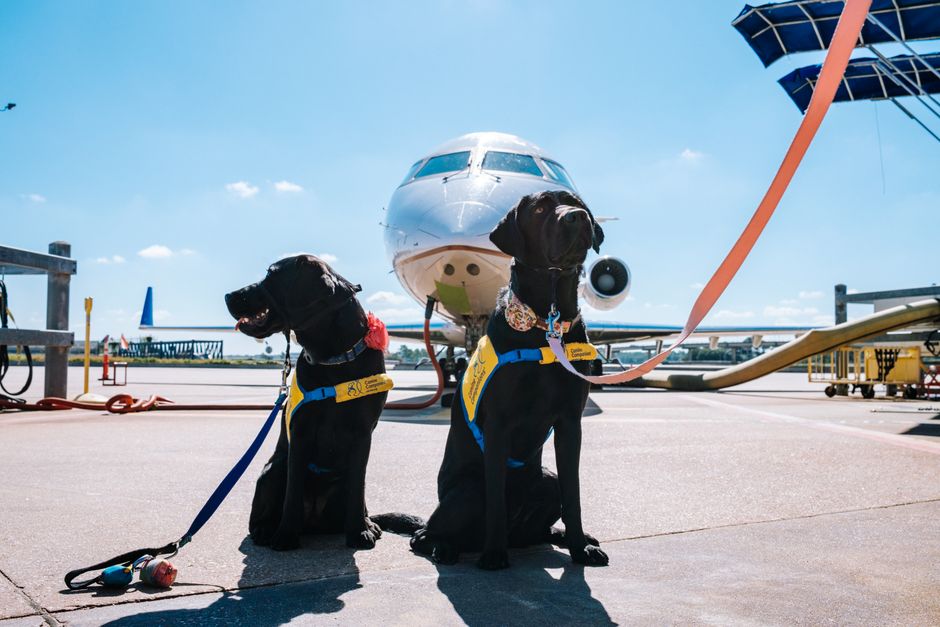
Do guide dogs fly for free? Yes, on all airlines including low-cost carriers, with official assistance dog documentation. They travel in the cabin with no carrier restrictions.
Can my dog fly if they're 6 months old? From a legal and airline standpoint, yes — there is no official minimum age. They do need to be up to date with vaccinations and have their passport or vaccination record in order. In practice, airlines may require a valid rabies vaccination, which cannot be given before 12 weeks of age.