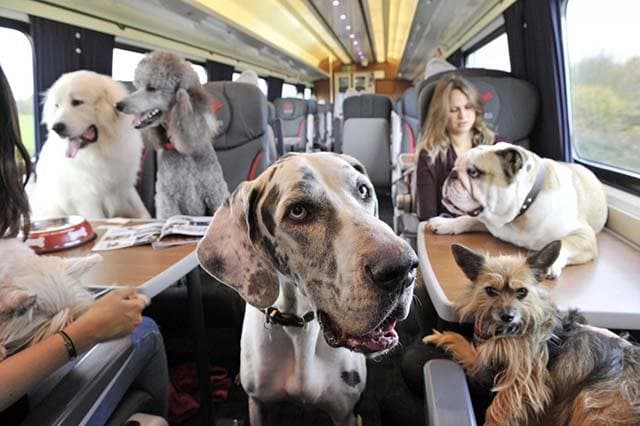
Train travel with dogs hit a major turning point in July 2026. Renfe (Spanish national rail) overhauled its pet policy, and dogs up to 40 kg can now board long-distance trains — including the AVE high-speed service — in dedicated pet carriages. It's a change that opens up real options for millions of medium and large dog owners who'd spent years unable to even consider the train as an alternative to the car.
How does it actually work? What about large dogs? And PPP (potentially dangerous breeds)? What do Ouigo and Iryo allow? What about regional trains? This guide covers the updated rules for every operator running services in Spain, so you arrive at the platform knowing exactly where you stand.
The big news: Renfe and dogs on long-distance trains
From July 2026, Renfe allows dogs up to 40 kg on long-distance services (AVE, Avant, Alvia, Intercity). Here's what you need to know:
What exactly changed? Renfe has set up dedicated pet carriages on long-distance trains. Your dog takes the seat next to yours, which Renfe automatically blocks when you buy the pet ticket.
How much does it cost? The supplement is €40 per journey. You buy it alongside your passenger ticket on renfe.com or at the ticket office.
What's required?
- Muzzle compulsory from the moment you enter the station
- Lead of no more than 1.5 metres, non-extendable, at all times
- Your dog occupies the adjacent seat (blocked by Renfe)
Who's excluded?
- Puppies under 1 year old
- Perros Potencialmente Peligrosos — PPP (officially designated dangerous breeds)
- Females in heat
That last one matters: if you're travelling with a female dog who's in heat, you'll need to find another way. No exceptions.
Important: not every train has a pet carriage available. Before buying your ticket, check on renfe.com that the specific service includes one. The booking system shows this during seat selection.
Renfe customer service: 912 320 320 Website: renfe.com

Renfe Cercanías (commuter) and Media Distancia (regional)
The rules here differ from long-distance — and in many ways, they're more relaxed.
Cercanías: dogs of any size are welcome. Your dog must wear a muzzle and be on a lead at all times. The pet ticket is free in most regions — though we'd recommend checking for yours, as the rules vary by autonomous community.
Media Distancia: same deal. Muzzle and lead, no size limit, free or reduced price depending on the route.
The key thing here: PPP dogs can travel on Cercanías and Media Distancia with a muzzle and lead — the exclusion only applies to the new long-distance pet carriages.
Small dogs in a carrier: the rules that haven't changed
If your travel companion weighs under 10 kg (dog and carrier combined), you can travel on most services without much hassle:
- The carrier must be hard-sided or semi-rigid, well-ventilated, and large enough for your dog to stand up and turn around
- It travels with you, at your feet or in your seat space — not in the overhead luggage rack
- On Cercanías: free or reduced price
- On long-distance: pet ticket required (roughly €5–15 depending on the route)
A carrier in the cabin works on almost every operator. It's also the most flexible option, since it doesn't depend on whether the train has a dedicated pet carriage.
Ouigo: the low-cost train option
Ouigo has its own pet policy, separate from Renfe:
- Small dogs in a carrier accepted (maximum 10 kg, dog and carrier combined)
- The pet ticket is added when booking at ouigo-spain.com (roughly €5–10)
- The carrier must meet the dimensions published on their website — check these before buying a new carrier
- Medium and large dogs not accepted, except accredited assistance dogs
- PPP dogs not accepted
Ouigo customer service: 91 922 14 17 Website: ouigo-spain.com
Iryo: stricter rules
Iryo, Spain's third high-speed operator, does allow pets on some services, but with tighter conditions:
- Small dogs in a carrier only
- Not all trains have pet spaces — check availability on iryo.eu when booking
- Pricing: check directly on the website
- Medium and large dogs not accepted, except assistance dogs
Website: iryo.eu

Regional operators: FGC, Euskotren, Rodalies
Beyond Renfe and the high-speed operators, there's a network of regional trains with their own rules.
FGC (Ferrocarrils de la Generalitat de Catalunya)
FGC is one of the most relaxed: dogs of any size travel free, with a muzzle and lead required.
Within the FGC network, a couple of special services also welcome dogs:
- Cremallera de Montserrat rack railway (Monistrol de Montserrat → Monistrol Vila): dogs welcome, free, muzzle and lead required
- Cremallera de la Vall de Núria rack railway (Ribes de Freser → Núria): dogs welcome, muzzle and lead required, no PPP. This is the only land access to the mountain station
FGC customer service: 93 205 15 15 Website: fgc.cat
Euskotren
The most dog-friendly operator on the whole peninsula. Euskotren accepts dogs of any size, no muzzle required, and it's completely free. If you're heading to the Basque Country, this is very good news.
Euskotren customer service: 94 433 95 00 Website: euskotren.eus
Rodalies de Catalunya (Renfe)
In Catalonia, Renfe-operated Rodalies services follow the Cercanías rules: any size, muzzle and lead, free or reduced price.
FEVE / Renfe in northern Spain
Renfe services in northern Spain (historically operated as FEVE) also apply the standard Cercanías rules for the relevant routes. Check for your specific journey.
Assistance dogs: guaranteed access everywhere
Guide dogs and officially accredited assistance dogs have guaranteed access on all train services, across every operator, at no extra cost and with no size restrictions. Carrying official accreditation documents is essential to exercise this right without any friction.
This applies even on services that exclude other dogs (like Eurostar) or where PPP breeds aren't permitted.
PPP dogs on trains: what's allowed and what isn't
Officially designated potentially dangerous breeds (Pit Bull Terrier, Staffordshire Bull Terrier, Rottweiler, Dogo Argentino, Fila Brasileiro, Tosa Inu, Akita Inu and similar crosses) have more limited access:
| Service | PPP accepted? | |---|---| | Renfe Cercanías | Yes, with muzzle and lead | | Renfe Media Distancia | Yes, with muzzle and lead | | Renfe long-distance (new 2026 rules) | No | | Ouigo | No | | Iryo | No | | FGC | Yes (except Cremallera Núria) | | Euskotren | Yes |
If you have a PPP dog, Cercanías and regional services give you the most options.
What it costs to travel by train with your dog: price overview
| Operator | Service type | Pet ticket (approx.) | Size accepted | |---|---|---|---| | Renfe Cercanías | Commuter | Free | Any, with muzzle | | Renfe Media Distancia | Regional | Reduced / free | Any, with muzzle | | Renfe long-distance (dogs <10kg) | AVE, Alvia... | €5–15 | Up to 10kg in carrier | | Renfe long-distance (new rules) | AVE, Alvia... | €40 | Up to 40kg in pet carriage | | Ouigo | Low-cost high-speed | €5–10 | Up to 10kg in carrier | | Iryo | High-speed | Check website | Up to 10kg in carrier | | FGC | Regional (Catalonia) | Free | Any, with muzzle | | Euskotren | Regional (Basque Country) | Free | Any |
Prices are approximate and subject to change. Always confirm on the official website before booking.
How to buy your pet ticket, step by step
On renfe.com:
- Enter your origin, destination, date and number of passengers as usual
- During seat selection, you'll see whether that particular train has pet spaces available
- Add the pet ticket (this option appears if spaces are available)
- The system automatically blocks the adjacent seat for your dog
- Pay for both tickets together
Important: pet spaces aren't always available, especially during peak season and weekends. Book ahead.
At the ticket office: you can also buy in person at the station, but some pet spaces sell out online before you reach the window.
What to bring so nothing catches you off guard
Dog's documents:
- Up-to-date vaccination record
- Registered microchip (legally required in Spain)
- EU pet passport if your journey crosses a border
- If an assistance dog: official accreditation certificate
- If a PPP: PPP licence, third-party liability insurance, muzzle on at all times
What goes in the bag:
- Muzzle (compulsory for larger dogs on many services — bring it even when it's not strictly required, it avoids arguments)
- Lead (no more than 1.5 m for services that specify this)
- Carrier if your dog is small (check it meets the operator's size requirements)
- Water and a collapsible bowl for longer journeys
- A favourite treat or toy
- Poo bags
Before you leave home:
- Confirm that specific train accepts pets (not just the operator in general)
- Buy the pet ticket online at the same time as yours, not at the station on the day
- Arrive at the station with a genuine time buffer — if there's a ticket issue, you'll need it
At the station and during the journey
At the entrance: most major stations have turnstiles and stairs. With a large dog, look for the reduced-mobility access points — they tend to have wide gates, ramps and lifts. It's not cheating; that's exactly what they're there for.
On the platform: if the service requires it, the muzzle should be on from the moment you enter the station. Don't leave it to the last second — it's the first thing a conductor will look for.
In the carriage: if your dog is in a carrier, it goes at your feet or in your seat space. If travelling on the adjacent seat under the new long-distance rules, make sure your dog is settled and not bothering other passengers.
Partially covering the carrier: many dogs calm down faster in semi-darkness. If yours is anxious, drape a light cloth or thin blanket over the carrier — it helps them feel more secure.
Travel sickness: trains tend to cause less motion sickness than cars, but it can still happen. Don't feed your dog in the 2–3 hours before the journey and keep water handy. More on this in our guide to [anxiety and travel sickness in the car].
International train travel
If your plans go beyond Spain, be ready for a patchwork of different rules. Every country does its own thing.
France (SNCF): small dogs (under 6 kg with bag) need their own ticket (~€7). Larger dogs pay half price and a muzzle is compulsory. Documentation to enter France (EU pet passport with rabies vaccination) is the same as for any other EU country.
Italy (Trenitalia): one of the most dog-friendly in Europe. Dogs of any size accepted with muzzle and lead. Small dogs in a carrier travel free; large dogs pay half price.
Germany (Deutsche Bahn): large dogs pay half price and a muzzle is compulsory. Small dogs travel free in a bag or basket. Very systematic, as you'd expect.
Portugal (CP): small dogs in a carrier travel free. Medium and large dogs: muzzle, lead and their own ticket required.
United Kingdom (post-Brexit): the trains themselves are fairly pet-friendly. The real challenge comes before you board: bringing a dog into the UK requires a microchip, a rabies vaccination with specific timing, antiparasitic treatment against Echinococcus, and an AHC (Animal Health Certificate) issued by an approved vet. If you don't have everything in order, you won't get in. Check the current requirements on the UK APHA website before making any plans.
Eurostar: guide dogs only. No exceptions for other dogs.
The bottom line: before buying any international ticket, go to the operator's website for the destination country and read their specific pet policy. What applies on Renfe doesn't apply on SNCF.
Frequently asked questions
Can I take my large dog on the AVE now? Yes, from July 2026 dogs up to 40 kg can travel on the AVE and other Renfe long-distance trains in dedicated pet carriages, with a €40 supplement. You'll need to check that the specific service has a pet carriage available when booking.
How much is the pet ticket on Renfe? On Cercanías, it's free in most regions. In the new long-distance pet carriages, €40 per journey. For small dogs in a carrier on long-distance, it varies (roughly €5–15). Confirm on renfe.com.
Can my PPP dog travel by train? On Renfe Cercanías and Media Distancia, yes (muzzle and lead required). In the new long-distance carriages, no — PPP breeds are explicitly excluded. On FGC and Euskotren, generally yes.
Is a muzzle required on the train? For dogs in a carrier, usually not. For medium and large dogs travelling outside a carrier, yes on most services. Bring one regardless.
Can assistance dogs travel for free? Yes, on all operators and all services, including the AVE. No charge and no restrictions.
Can I book the pet ticket online? With Renfe, yes — on renfe.com at the same time as your own ticket. With Ouigo, also when booking. With Iryo, check their website. Recommended: always online, in advance.
What if my carrier doesn't meet the size requirements? The conductor can stop you from boarding. Check the operator's specifications before buying a carrier, or compare yours against their published limits. Better to sort it at home than find out on the platform.
Can my puppy travel in the new long-distance carriage? No. Puppies under 1 year are excluded from Renfe's new long-distance pet carriages. They can travel on Cercanías and Media Distancia.
Can I travel from Madrid to Barcelona by train with a 30 kg dog? Yes, from July 2026. The Madrid–Barcelona AVE has services with pet carriages. Cost: your ticket plus the €40 pet supplement. Book ahead — pet spaces are limited.